
Vol 3: The Nightmare Before Shiftmas
Some memes, news stories you should probably care about and a deep dive on surviving nightshifts, right at the moment HCPs everywhere are just trying to survive a heatwave. We see you.

A note from this month’s guest editor, Dr Jonathan Andrews, a doctor who qualified in 2015 and has since lost count of the nights he has spent on call.
My first proper night shift, I stood at a desk at 4am, utterly unable to work out whether I had already prescribed something or just thought very hard about prescribing it. I checked the drug chart three times. That was the night I learned the thing nobody mentions at medical school. Nights are not just days with worse lighting. They are a different job, done by a slightly different version of you, and that version needs looking after.
Ten years on, here is what I have learned since. The clinical bit gets easier. The human bit does not, unless you are deliberate about it. A long stretch of nights can feel like a sentence you’re serving, and the ones who come through it well are not the toughest, they are the ones who prepare. We all know the drill…nap before, eat well, wind down properly afterwards. Doing it is another thing entirely, especially when you find yourself knee deep in a box of Quality Street sitting on the nurses’ station on your 3am round.
So this edition is for everyone surviving the nights right now. We have the unhinged-but-it-works survival guide, and stories from the floor from people who have lived them. I have also kept the Q word out of this intro entirely, because I am not reckless.
In other news: PCOS has a new name after a 14,000-strong global consensus, the case is building that lung cancer in women is a distinct disease, and the resident doctors’ strike was called off at the eleventh hour after a fresh government offer. Plenty to distract from this never-ending heatwave!
Look after yourselves out there, and try to get some good quality sleep and recovery time. Not just four hours between nights - yes, I’m looking at you. We’ve all been there 🫶🏾
Johnny :)
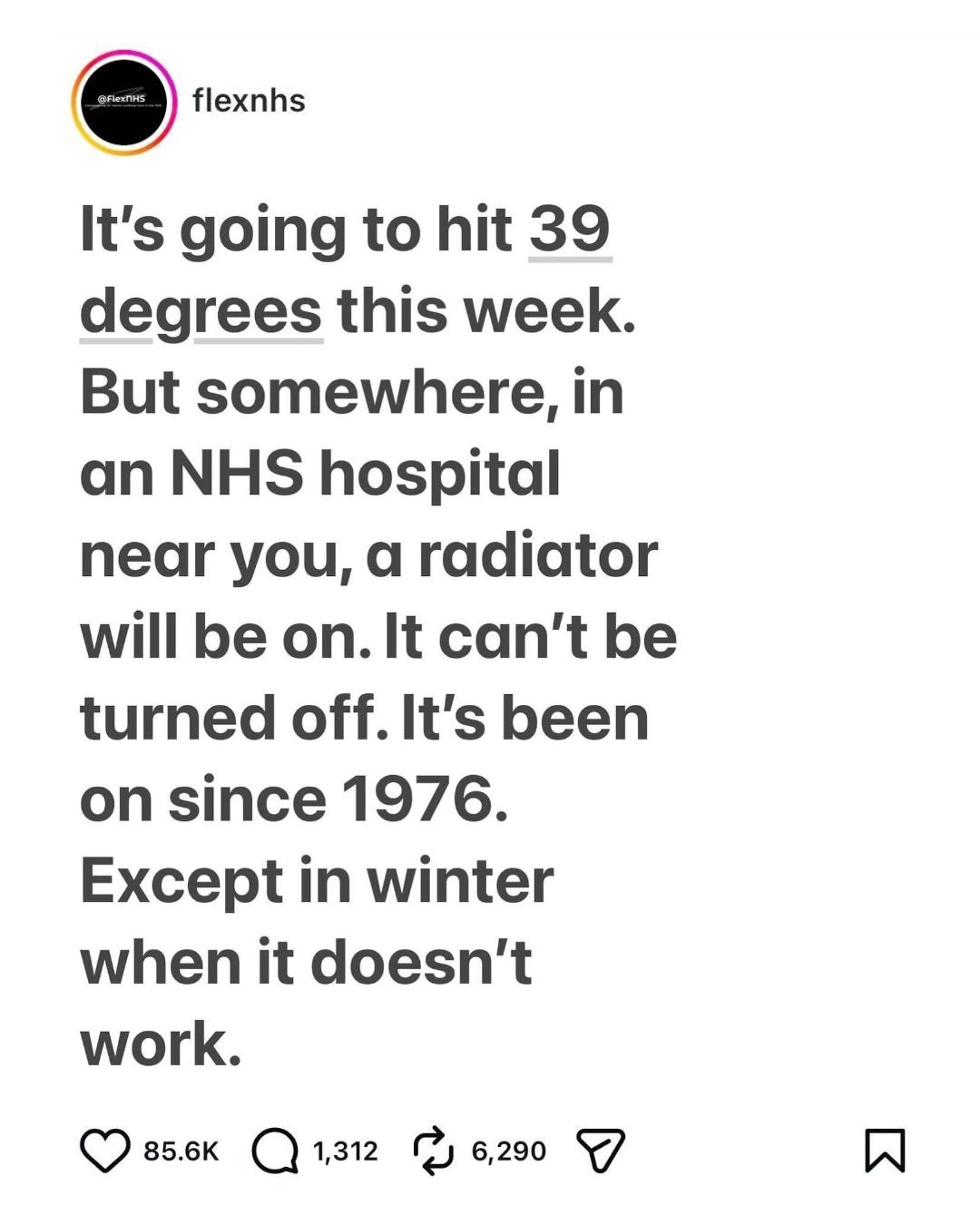
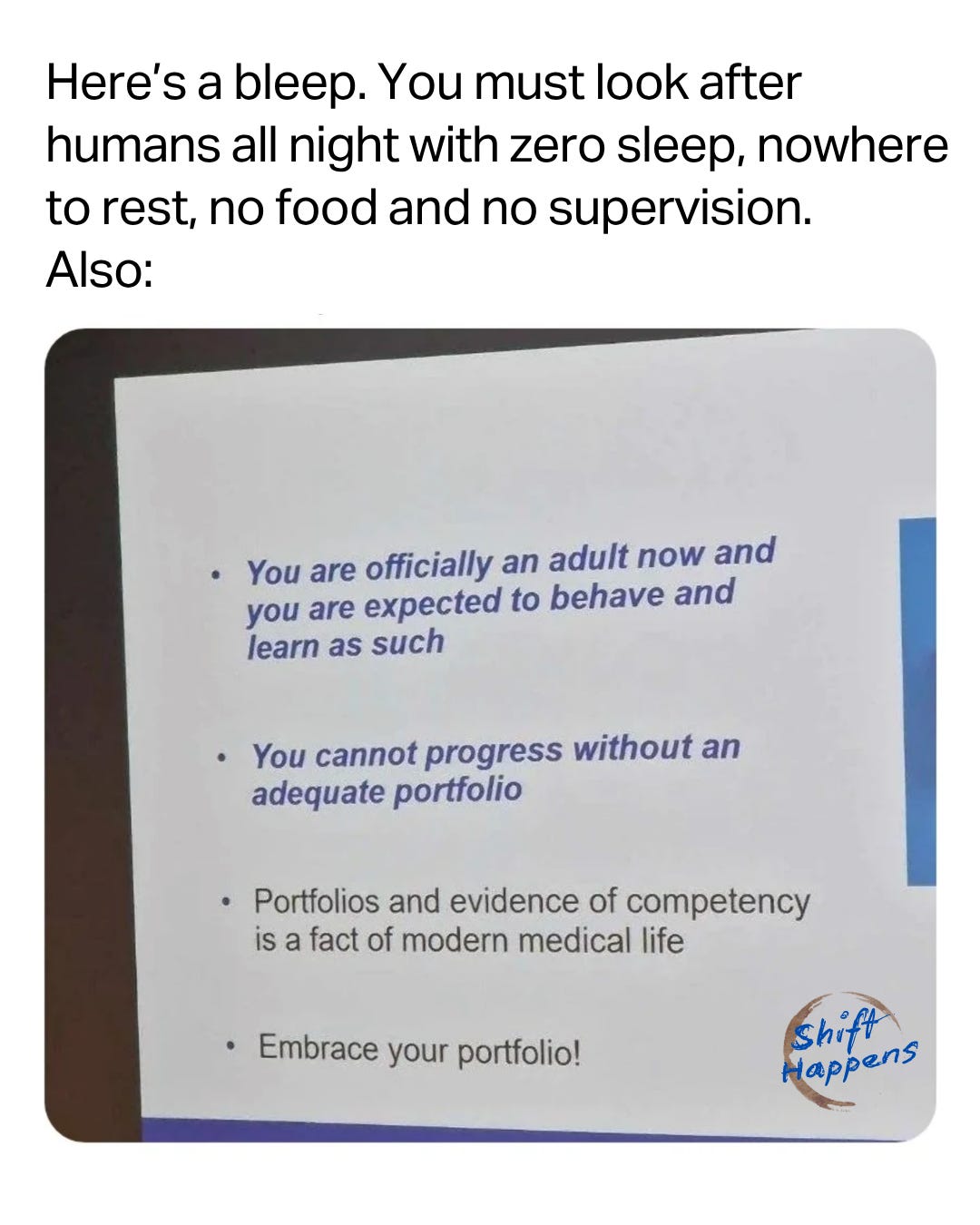
Thoughts, prayers and virtual iced-coffees to anyone working shifts on an NHS ward right now. Hang in there 🫶 Credit @flexnhs
And then there’s night shifts…
Polyendocrine metabolic ovarian syndrome - the new name for polycystic ovary syndrome
PCOS has a new name following a global consensus process involving over 14,000 patients and clinicians. Polyendocrine metabolic ovarian syndrome (PMOS) better reflects the fact that it is a multisystem endocrine and metabolic disorder, not an ambiguous problem that may or may not involve ovarian cysts. With one in eight women affected, and clinicians spending years explaining why the old name was misleading, it’s a long-overdue fix.
Lung cancer in women emerges as a distinct disease
Lung cancer is now overtaking breast cancer as the leading cause of cancer death in women in many countries. But the research, screening and treatment protocols have been built almost entirely around men. Nature makes the case that lung cancer in women is a distinct disease, driven by different biology, different risk factors and different responses to treatment, and that the clinical system is failing women at every stage from diagnosis to dosing.
Resident doctors cancel strike after new offer from government
The 16th resident doctors’ strike since 2023 was called off at the eleventh hour after the government tabled a new offer. The BMA has agreed to no extra money this year, but faster pay progression in 2026, 4,500 additional training places and exam fees covered. Still gotta get through the vote though… 👀
You Okay, Doc launches exhibition with Barts NHS Trust at The Royal London
Dr Anthony Allnatt, a consultant anaesthetist at Barts Health who was on the frontline during the 7/7 bombings, later developed PTSD and spent seven years in psychiatric treatment, has had a piece of artwork unveiled in his honour at The Royal London Hospital. He subsequently founded the Theatre Wellbeing Project, which embeds psychological support directly into the working day for theatre staff. Drawing on the Japanese art of Kintsugi and the idea that the cracks are part of the story, not something to be hidden, the artwork, Held Between Shifts, is an incredible collaboration with our friends at You Okay, Doc?, whose CEO Lou Adams kindly guest edited our last edition of Shift Happens.
Been There By Charlie Rogers
Let’s not get it twisted, night shifts in healthcare can be some of the most chaotic and demanding shifts of your life. One minute you’ll be nodding off from sleep deprivation, the next you’ll be called to one of the worst scenarios of your career. We all know that feeling of getting home and using your hospital keycard to try to open your front door, or fumbling to find your phone, only to realise it was in your hand the whole time.
If you’re new to medicine or night shifts, you might find some of my content useful for how to best prepare. To settle your nerves, here’s an anecdote from my time on nights:
Picture this… It’s your fourth night shift in a row, you’re delirious, sleep-deprived, dehydrated, and have eaten enough calories (which don’t count on nights, by the way) to sustain you for the next week. You’re asked to re-cannulate a patient at 6:30am because no one else is available.
You muster your courage, prepare the equipment and head to the bedside. You introduce yourself, explain what you’re about to do, wrap the tourniquet, and give the area a clean. Just two more hours, Charlie. You can do this. You reach back into your tray and realise you never actually picked up a cannula.
You discreetly inform the patient that you need to grab some extra equipment. You return, repeat the steps, look down and realise you’ve forgotten the saline flush. Again, trying to hide the obvious embarrassment on your bedraggled face, you apologise and go back for it.
This time, filled with a new sense of confidence, you start cannulating, making small talk as you go. Eventually, the conversation turns to what they do for a living. They tell you they’re a consultant doctor. You finish the cannula, fairly certain you look like the most inexperienced member of staff they’ve ever interacted with. They looked at me, laughed, and simply said: “Don’t worry, I’ve been there too.”
I’ve been charting my journey as a medic online, so come along for the ride. Find me on Instagram @thedrrogers and TikTok at @thedrrogers 👇

Nights with Nurse Cait also has great content on night shift life. Here are five things she would’ve paid to know before doing 8+ years of nights as a nurse.
The unhinged-but-it-works nights survival guide
By people who’ve done them. Some evidence-based, some anecdotal, some just ju-ju.
Sacred superstitions 🧿
Never say the Q word. Not before the shift, not during, not even in your head. One murmur and the ward will combust.
Never say a frequent flyer’s name out loud unless you’re manifesting them as your next admission. Tip: rhyming with the name won’t save you. Lore is lore.
Full moon = full ward. Did a Scorpio do something rogue? Is it Mercury again? Who knows. Unscientific, universally observed.
There is a point in a night shift where you’ve been working yesterday, today and tomorrow in the same 24 hours. You didn’t even need a DeLorean.
Caffeine strategy ☕
The ‘caffeine nap’ is real but feels chaotic. Drink caffeine right before a 20-minute power nap so it kicks in when you wake up. This is RCP-endorsed. Honestly.
Stop all caffeine 6–8 hours before your post-shift sleep or you will lie awake in bright daylight feeling completely unhinged. Feels at odds with the above, but 🤷
Resident doctors are reportedly more likely to be dehydrated than their patients (believable). On that basis, you probably aren’t drinking enough water.
Food crimes 🍫
Apparently, 84% of NHS staff have no access to hot food on nights, which is frankly a public health crisis within a public health service.
Low-carb, high-protein is what the ‘evidence’ recommends, but try saying no to a tub of Quality Street or someone’s mum’s brownies at 3am.
Never touch the last biscuit. That belongs to whoever had the worst night.
Sleep hacks 😴
Take a 2-hour prophylactic nap the afternoon before your first night. Only 35% of junior doctors actually do this, despite it being official guidance.
Blackout blinds, earplugs, eye mask, sunglasses on the drive home. To be clear: save the blinds, earplugs and eye mask for when you’re actually home, not the drive home.
On a serious note: sleep deprivation at 24 hours impairs you to the equivalent of a blood alcohol level of 0.10% — over the legal drink-drive limit. If you feel drowsy, pull over. No handover, no commute, no obligation is worth your life or someone else’s.
Do not go straight to bed when you get home. Wind down first. Nobody does this, but everybody should.
Ward tactics 🏥
Know which on-call consultant is kind at 4am and which will make you feel like a criminal for calling. Gather this intelligence like your life depends on it. (It does.)
Human alertness reliably drops between 3–4am, so if you can — and ‘if’ is doing some heavy lifting here — don’t schedule your hardest tasks then.
The post-shift car sit is universal and necessary. You will sit in the car park for 10 minutes before you can move. This is fine. If you need a quick nap, take one. Stay safe.
Normal life survival 🙅
If you need to have a difficult conversation after a night shift, wait.
Your family will not understand why you’re crying at a Tesco self-checkout. You are not broken — you are post-nights. These are two different things.
The post-nights grocery run is a trap. You will go in for milk wearing your coat inside out and leave with £47 of things you don’t need.
And in case you need them, other resources to save
All jokes aside, here are some useful places to go if you need extra support:
You Okay, Doc? and the YOD text line: text YOD to 85258
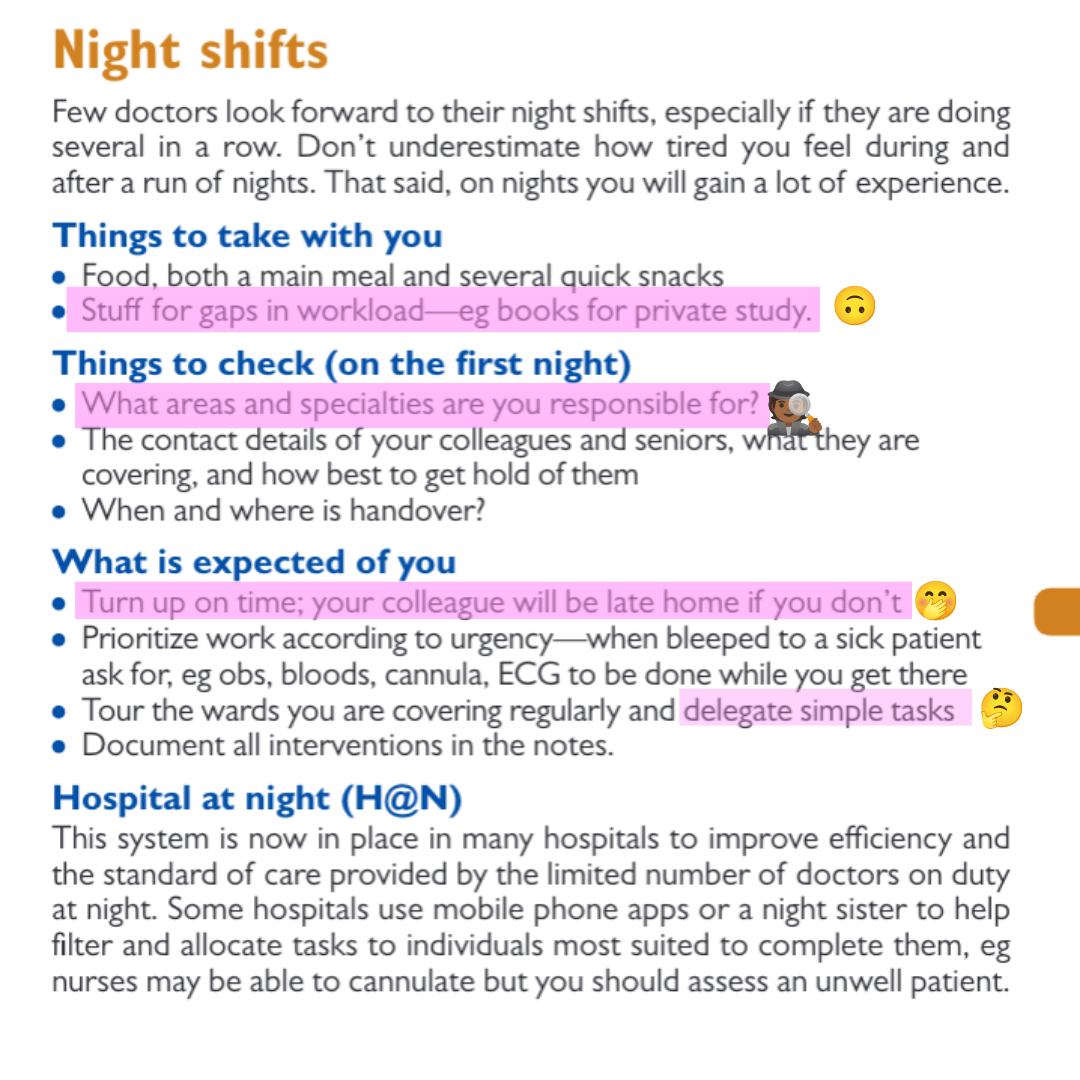
And finally, some of our favourite advice from the Oxford Handbook for the Foundation Programme…
Opportunities
⛷️ The Leap Healthtech Leadership Workshop, Central London - For clinicians who’ve ever sat in a meeting thinking “I could fix this” but weren’t quite sure where to start. A one-day workshop helping healthcare professionals make the jump into healthtech leadership. Practical, London-based, and worth a day of your annual / study leave.
💻 BiteLabs UK Digital Health, AI & Innovation Fellowship - Autumn 2026 - If your opinions on AI in healthcare go beyond “it’s either going to save us or get us struck off,” this fellowship might be your wheelhouse. BiteLabs brings together clinicians serious about shaping how digital health actually develops. Applications are open now for the Autumn 2026 cohort.
❤️ British Heart Foundation Clinical Research Training Fellowship - Funded research time, protected from the ward, doing work that might change how we treat heart disease. Open to clinicians who want to pursue cardiovascular research. Competitive, prestigious, and a good reason to dust off your research brain.
🩺 RCP Chief Registrar Programme - A funded year to develop leadership skills without having to pretend management is something you fell into by accident. Run by the Royal College of Physicians for registrars who want to get better at the things medical school doesn’t cover: culture, quality improvement, and how to actually change things from the inside.
🫂 You Okay, Doc? Ambassadors - An opportunity to use your voice and network to champion healthcare worker wellbeing, wherever you are in your career. Whether that's speaking at conferences, supporting campaigns or just starting the conversations that need to happen on your ward, applications are open to healthcare professionals at all levels. Send an expression of interest of up to 1,000 words to info@youokaydoc.org.uk by 30 June. Chop, chop!
Pods
Nursing Planet Podcast host Alisha sits down with palliative care nurse Charlotte to talk about the emotional realities of working with death and dying. They cover the personal toll it takes on nurses, coping strategies, and make the case for why healthcare needs to get more comfortable having honest conversations about grief — with patients and with each other.
The Why Medics Matter team spoke to Dr Ellen Knox, consultant obstetrician and postgraduate dean, about something medicine has traditionally found too easy to sideline: Sexual misconduct in the NHS. They cover why it’s taken this long to call it out and what needs to change. See also this Instagram Reel from Dr Annabel Sowemimo on the same topic.
Meet the doctor who swapped overnight on-call rotas for a decade at McKinsey, then came back to the NHS and invented his own role. Dr Rishi Das-Gupta talks to Dr Jing Ouyang about building a Chief Innovation Officer position from scratch, why implementation beats strategy every time, and what genuinely good digital transformation looks like from the inside.
That’s it for this month, but if you’d like to be a contributor, let us know here - we’ll shout you coffee! And if you’re not subscribed…👇